

How AES Works
Bringing It All Together
1. Đề bài
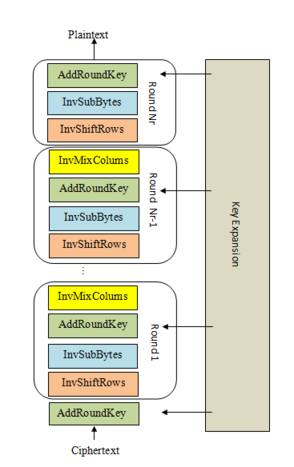 We’ve provided the key expansion code, and ciphertext that’s been properly encrypted by AES-128. Copy in all the building blocks you’ve coded so far, and complete the decrypt function that implements the steps shown in the diagram. The decrypted plaintext is the flag.
2. Phân tích
Bài này yêu cầu ta xây dựng 1 cấu trúc giải mã AES-128 ($N_{rounds} = 10$) từ các kiến thức đã học được từ các bài trước.
Cụ thể ta cần giải mã ngược dựa theo cấu trúc mã hóa:
- Dùng hàm
expand_keyđể biếnmaster_keytừ dãy 16 bytes thành $N_{rounds}+1 = 11$round_keyđể áp dụng vào mỗi round. - Các hàm
AddRoundKey,InvShiftRows,InvSubBytes,InvMixColumnslần lượt được áp dụng theo đúng thứ tự nghịch đảo của mô hình cấu trúc AES. - Quá trình giải mã xuất phát từ round cuối (Round 10): Cho ciphertext đi qua hàm
AddRoundKeyđầu tiên (với round_keys[10]), sau đó trải qua $N_{rounds}-1 = 9$ round biến đổi lặp lại theo thứ tự:InvShiftRows$\rightarrow$InvSubBytes$\rightarrow$AddRoundKey$\rightarrow$InvMixColumns - Ở round cuối cùng (Round 0), ta thực hiện tương tự nhưng bỏ qua hàm
InvMixColumns.
Bài này giúp ta hiểu rõ hơn cấu trúc của một hàm mã hóa cũng như giải mã AES cơ bản.
Trong thực tế hoặc các bài toán chuẩn, ta có thể dùng trực tiếp thư việnCrypto.Cipherđể giải mã ngắn gọn:
from Crypto.Cipher import AES
plaintext = AES.new(key, AES.MODE_ECB).decrypt(ciphertext)
print(plaintext)
3. Lời giải
N_ROUNDS = 10

key = b'\xc3,\\\xa6\xb5\x80^\x0c\xdb\x8d\xa5z*\xb6\xfe\\'
ciphertext = b'\xd1O\x14j\xa4+O\xb6\xa1\xc4\x08B)\x8f\x12\xdd'

S_BOX = (
    0x63, 0x7C, 0x77, 0x7B, 0xF2, 0x6B, 0x6F, 0xC5, 0x30, 0x01, 0x67, 0x2B, 0xFE, 0xD7, 0xAB, 0x76,
    0xCA, 0x82, 0xC9, 0x7D, 0xFA, 0x59, 0x47, 0xF0, 0xAD, 0xD4, 0xA2, 0xAF, 0x9C, 0xA4, 0x72, 0xC0,
    0xB7, 0xFD, 0x93, 0x26, 0x36, 0x3F, 0xF7, 0xCC, 0x34, 0xA5, 0xE5, 0xF1, 0x71, 0xD8, 0x31, 0x15,
    0x04, 0xC7, 0x23, 0xC3, 0x18, 0x96, 0x05, 0x9A, 0x07, 0x12, 0x80, 0xE2, 0xEB, 0x27, 0xB2, 0x75,
    0x09, 0x83, 0x2C, 0x1A, 0x1B, 0x6E, 0x5A, 0xA0, 0x52, 0x3B, 0xD6, 0xB3, 0x29, 0xE3, 0x2F, 0x84,
    0x53, 0xD1, 0x00, 0xED, 0x20, 0xFC, 0xB1, 0x5B, 0x6A, 0xCB, 0xBE, 0x39, 0x4A, 0x4C, 0x58, 0xCF,
    0xD0, 0xEF, 0xAA, 0xFB, 0x43, 0x4D, 0x33, 0x85, 0x45, 0xF9, 0x02, 0x7F, 0x50, 0x3C, 0x9F, 0xA8,
    0x51, 0xA3, 0x40, 0x8F, 0x92, 0x9D, 0x38, 0xF5, 0xBC, 0xB6, 0xDA, 0x21, 0x10, 0xFF, 0xF3, 0xD2,
    0xCD, 0x0C, 0x13, 0xEC, 0x5F, 0x97, 0x44, 0x17, 0xC4, 0xA7, 0x7E, 0x3D, 0x64, 0x5D, 0x19, 0x73,
    0x60, 0x81, 0x4F, 0xDC, 0x22, 0x2A, 0x90, 0x88, 0x46, 0xEE, 0xB8, 0x14, 0xDE, 0x5E, 0x0B, 0xDB,
    0xE0, 0x32, 0x3A, 0x0A, 0x49, 0x06, 0x24, 0x5C, 0xC2, 0xD3, 0xAC, 0x62, 0x91, 0x95, 0xE4, 0x79,
    0xE7, 0xC8, 0x37, 0x6D, 0x8D, 0xD5, 0x4E, 0xA9, 0x6C, 0x56, 0xF4, 0xEA, 0x65, 0x7A, 0xAE, 0x08,
    0xBA, 0x78, 0x25, 0x2E, 0x1C, 0xA6, 0xB4, 0xC6, 0xE8, 0xDD, 0x74, 0x1F, 0x4B, 0xBD, 0x8B, 0x8A,
    0x70, 0x3E, 0xB5, 0x66, 0x48, 0x03, 0xF6, 0x0E, 0x61, 0x35, 0x57, 0xB9, 0x86, 0xC1, 0x1D, 0x9E,
    0xE1, 0xF8, 0x98, 0x11, 0x69, 0xD9, 0x8E, 0x94, 0x9B, 0x1E, 0x87, 0xE9, 0xCE, 0x55, 0x28, 0xDF,
    0x8C, 0xA1, 0x89, 0x0D, 0xBF, 0xE6, 0x42, 0x68, 0x41, 0x99, 0x2D, 0x0F, 0xB0, 0x54, 0xBB, 0x16,
)

INV_S_BOX = (
    0x52, 0x09, 0x6A, 0xD5, 0x30, 0x36, 0xA5, 0x38, 0xBF, 0x40, 0xA3, 0x9E, 0x81, 0xF3, 0xD7, 0xFB,
    0x7C, 0xE3, 0x39, 0x82, 0x9B, 0x2F, 0xFF, 0x87, 0x34, 0x8E, 0x43, 0x44, 0xC4, 0xDE, 0xE9, 0xCB,
    0x54, 0x7B, 0x94, 0x32, 0xA6, 0xC2, 0x23, 0x3D, 0xEE, 0x4C, 0x95, 0x0B, 0x42, 0xFA, 0xC3, 0x4E,
    0x08, 0x2E, 0xA1, 0x66, 0x28, 0xD9, 0x24, 0xB2, 0x76, 0x5B, 0xA2, 0x49, 0x6D, 0x8B, 0xD1, 0x25,
    0x72, 0xF8, 0xF6, 0x64, 0x86, 0x68, 0x98, 0x16, 0xD4, 0xA4, 0x5C, 0xCC, 0x5D, 0x65, 0xB6, 0x92,
    0x6C, 0x70, 0x48, 0x50, 0xFD, 0xED, 0xB9, 0xDA, 0x5E, 0x15, 0x46, 0x57, 0xA7, 0x8D, 0x9D, 0x84,
    0x90, 0xD8, 0xAB, 0x00, 0x8C, 0xBC, 0xD3, 0x0A, 0xF7, 0xE4, 0x58, 0x05, 0xB8, 0xB3, 0x45, 0x06,
    0xD0, 0x2C, 0x1E, 0x8F, 0xCA, 0x3F, 0x0F, 0x02, 0xC1, 0xAF, 0xBD, 0x03, 0x01, 0x13, 0x8A, 0x6B,
    0x3A, 0x91, 0x11, 0x41, 0x4F, 0x67, 0xDC, 0xEA, 0x97, 0xF2, 0xCF, 0xCE, 0xF0, 0xB4, 0xE6, 0x73,
    0x96, 0xAC, 0x74, 0x22, 0xE7, 0xAD, 0x35, 0x85, 0xE2, 0xF9, 0x37, 0xE8, 0x1C, 0x75, 0xDF, 0x6E,
    0x47, 0xF1, 0x1A, 0x71, 0x1D, 0x29, 0xC5, 0x89, 0x6F, 0xB7, 0x62, 0x0E, 0xAA, 0x18, 0xBE, 0x1B,
    0xFC, 0x56, 0x3E, 0x4B, 0xC6, 0xD2, 0x79, 0x20, 0x9A, 0xDB, 0xC0, 0xFE, 0x78, 0xCD, 0x5A, 0xF4,
    0x1F, 0xDD, 0xA8, 0x33, 0x88, 0x07, 0xC7, 0x31, 0xB1, 0x12, 0x10, 0x59, 0x27, 0x80, 0xEC, 0x5F,
    0x60, 0x51, 0x7F, 0xA9, 0x19, 0xB5, 0x4A, 0x0D, 0x2D, 0xE5, 0x7A, 0x9F, 0x93, 0xC9, 0x9C, 0xEF,
    0xA0, 0xE0, 0x3B, 0x4D, 0xAE, 0x2A, 0xF5, 0xB0, 0xC8, 0xEB, 0xBB, 0x3C, 0x83, 0x53, 0x99, 0x61,
    0x17, 0x2B, 0x04, 0x7E, 0xBA, 0x77, 0xD6, 0x26, 0xE1, 0x69, 0x14, 0x63, 0x55, 0x21, 0x0C, 0x7D,
)

R_CON = (
    0x00, 0x01, 0x02, 0x04, 0x08, 0x10, 0x20, 0x40,
    0x80, 0x1B, 0x36, 0x6C, 0xD8, 0xAB, 0x4D, 0x9A,
    0x2F, 0x5E, 0xBC, 0x63, 0xC6, 0x97, 0x35, 0x6A,
    0xD4, 0xB3, 0x7D, 0xFA, 0xEF, 0xC5, 0x91, 0x39,
)

def bytes2matrix(text):
    return [list(text[i:i+4]) for i in range(0, len(text), 4)]

def matrix2bytes(matrix):
    return bytes(sum(matrix, []))

def xtime(a):
    return (((a << 1) ^ 0x1B) & 0xFF) if (a & 0x80) else (a << 1)

def add_round_key(s, k):
    for row in range(4):
        for col in range(4):
            s[row][col] ^= k[row][col]
    return s

def inv_sub_bytes(s):
    for row in range(4):
        for col in range(4):
            s[row][col] = INV_S_BOX[s[row][col]]
    return s

def inv_shift_rows(s):
    s[0][1], s[1][1], s[2][1], s[3][1] = s[3][1], s[0][1], s[1][1], s[2][1]
    s[0][2], s[1][2], s[2][2], s[3][2] = s[2][2], s[3][2], s[0][2], s[1][2]
    s[0][3], s[1][3], s[2][3], s[3][3] = s[1][3], s[2][3], s[3][3], s[0][3]
    return s

def mix_columns(s):
    for col in range(4):
        a = s[col]
        t = a[0] ^ a[1] ^ a[2] ^ a[3]
        u = a[0]
        a[0] ^= t ^ xtime(a[0] ^ a[1])
        a[1] ^= t ^ xtime(a[1] ^ a[2])
        a[2] ^= t ^ xtime(a[2] ^ a[3])
        a[3] ^= t ^ xtime(a[3] ^ u)
    return s

def inv_mix_columns(s):
    for col in range(4):
        u = xtime(xtime(s[col][0] ^ s[col][2]))
        v = xtime(xtime(s[col][1] ^ s[col][3]))
        s[col][0] ^= u
        s[col][1] ^= v
        s[col][2] ^= u
        s[col][3] ^= v
    return mix_columns(s)
def expand_key(master_key):
    key_columns = bytes2matrix(master_key)
    iteration_size = len(master_key) // 4

    rcon_idx = 1
    while len(key_columns) < (N_ROUNDS + 1) * 4:
        word = list(key_columns[-1])

        if len(key_columns) % iteration_size == 0:
            word.append(word.pop(0))
            word = [S_BOX[b] for b in word]
            word[0] ^= R_CON[rcon_idx]
            rcon_idx += 1
        elif len(master_key) == 32 and len(key_columns) % iteration_size == 4:
            word = [S_BOX[b] for b in word]

        word = bytes(b1 ^ b2 for b1, b2 in zip(word, key_columns[-iteration_size]))
        key_columns.append(word)

    return [key_columns[4*i : 4*(i+1)] for i in range(len(key_columns) // 4)]

def decrypt(key, ciphertext):
    round_keys = expand_key(key)
    s = bytes2matrix(ciphertext)

    s = add_round_key(s, round_keys[N_ROUNDS])

    for i in range(N_ROUNDS - 1, 0, -1):
        s = inv_shift_rows(s)
        s = inv_sub_bytes(s)
        s = add_round_key(s, round_keys[i])
        s = inv_mix_columns(s)

    s = inv_shift_rows(s)
    s = inv_sub_bytes(s)
    s = add_round_key(s, round_keys[0])

    return matrix2bytes(s)

if __name__ == "__main__":
    plaintext = decrypt(key, ciphertext)
    print(plaintext)
Flag: crypto{MYAES128}
Symmetric Starter
Modes of Operation Starter
1. Đề bài
The previous set of challenges showed how AES performs a keyed permutation on a block of data. In practice, we need to encrypt messages much longer than a single block. A mode of operation describes how to use a cipher like AES on longer messages.
All modes have serious weaknesses when used incorrectly. The challenges in this category take you to a different section of the website where you can interact with APIs and exploit those weaknesses. Get yourself acquainted with the interface and use it to take your next flag! Play at https://aes.cryptohack.org/block_cipher_starter
2. Phân tích
Truy cập đường link ta thấy được hình ảnh mô tả thuật mã hóa và source code của nó
from Crypto.Cipher import AES


KEY = ?
FLAG = ?


@chal.route('/block_cipher_starter/decrypt/<ciphertext>/')
def decrypt(ciphertext):
    ciphertext = bytes.fromhex(ciphertext)

    cipher = AES.new(KEY, AES.MODE_ECB)
    try:
        decrypted = cipher.decrypt(ciphertext)
    except ValueError as e:
        return {"error": str(e)}

    return {"plaintext": decrypted.hex()}


@chal.route('/block_cipher_starter/encrypt_flag/')
def encrypt_flag():
    cipher = AES.new(KEY, AES.MODE_ECB)
    encrypted = cipher.encrypt(FLAG.encode())

    return {"ciphertext": encrypted.hex()}
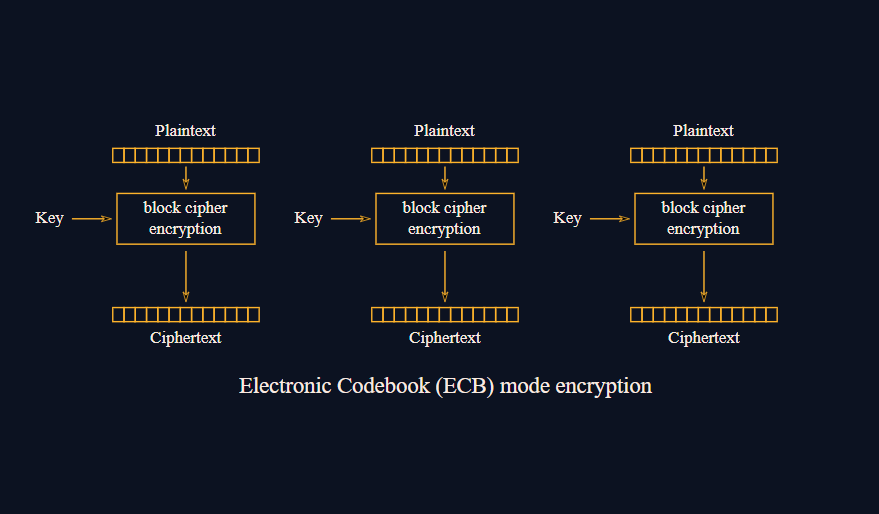
Chế độ ECB (Electronic Codebook)
- Ở chế độ này,
plaintextđược chia thành các khối 16 bytes độc lập và mỗi khối đều dùng chung mộtKeyđể mã hóa ra các khốiCiphertextriêng biệt.
Mục đích chính của bài là giới thiệu mode ECB và giúp ta làm quen với giao diện tương tác API của CryptoHack.
3. Lời giải
Trên giao diện web, có thể lấy được flag qua các bước sau:
Nhấn nút SUBMIT ở mục ENCRYPT_FLAG() -> nhận về JSON chứa
ciphertext.Copy chuỗi
ciphertextđó dán vào ô ciphertext của mục DECRYPT(…) ngay bên dưới rồi bấm SUBMIT.Nhận về chuỗi Hex
plaintext, decode ở mục Hex Encoder/Decoder để lấy được flag.
Ta cũng có thể sử dụng thư viện requests để tương tác trực tiếp với API của CryptoHack:
import requests

BASE_URL = "http://aes.cryptohack.org/block_cipher_starter"

r_encrypt = requests.get(f"{BASE_URL}/encrypt_flag/")
data_encrypt = r_encrypt.json()
ciphertext = data_encrypt["ciphertext"]
print(f"[+] Ciphertext: {ciphertext}")

r_decrypt = requests.get(f"{BASE_URL}/decrypt/{ciphertext}/")
data_decrypt = r_decrypt.json()
plaintext_hex = data_decrypt["plaintext"]
print(f"[+] Plaintext (Hex): {plaintext_hex}")

flag = bytes.fromhex(plaintext_hex).decode('utf-8')
print(f"[+] Flag: {flag}")
Flag: crypto{bl0ck_c1ph3r5_4r3_f457_!}
Passwords as Keys
1. Đề bài
It is essential that keys in symmetric-key algorithms are random bytes, instead of passwords or other predictable data. The random bytes should be generated using a cryptographically-secure pseudorandom number generator (CSPRNG). If the keys are predictable in any way, then the security level of the cipher is reduced and it may be possible for an attacker who gets access to the ciphertext to decrypt it.
Just because a key looks like it is formed of random bytes, does not mean that it necessarily is. In this case the key has been derived from a simple password using a hashing function, which makes the ciphertext crackable.
For this challenge you may script your HTTP requests to the endpoints, or alternatively attack the ciphertext offline. Good luck!
Play at https://aes.cryptohack.org/passwords_as_keys
2. Phân tích
Source code:
from Crypto.Cipher import AES
import hashlib
import random


# /usr/share/dict/words from
# https://gist.githubusercontent.com/wchargin/8927565/raw/d9783627c731268fb2935a731a618aa8e95cf465/words
with open("/usr/share/dict/words") as f:
    words = [w.strip() for w in f.readlines()]
keyword = random.choice(words)

KEY = hashlib.md5(keyword.encode()).digest()
FLAG = ?


@chal.route('/passwords_as_keys/decrypt/<ciphertext>/<password_hash>/')
def decrypt(ciphertext, password_hash):
    ciphertext = bytes.fromhex(ciphertext)
    key = bytes.fromhex(password_hash)

    cipher = AES.new(key, AES.MODE_ECB)
    try:
        decrypted = cipher.decrypt(ciphertext)
    except ValueError as e:
        return {"error": str(e)}

    return {"plaintext": decrypted.hex()}


@chal.route('/passwords_as_keys/encrypt_flag/')
def encrypt_flag():
    cipher = AES.new(KEY, AES.MODE_ECB)
    encrypted = cipher.encrypt(FLAG.encode())

    return {"ciphertext": encrypted.hex()}
Bài này vẫn là chế độ AES-ECB, nhưng key không còn cố định mà được lấy ngẫu nhiên một từ trong danh sách từ điển (words), sau đó băm MD5 để làm KEY 16 bytes (128 bits) cho AES.
Để giải quyết bài này ta cần brute force, giải mã với lần lượt các key được tạo từ danh sách và dừng lại đến khi lấy được chuỗi bắt đầu với crypto{.
3. Lời giải
import hashlib
import requests
from Crypto.Cipher import AES

BASE_URL = "http://aes.cryptohack.org/passwords_as_keys"

r = requests.get(f"{BASE_URL}/encrypt_flag/").json()
ciphertext_hex = r["ciphertext"]
ciphertext = bytes.fromhex(ciphertext_hex)

WORDS_URL = "https://gist.githubusercontent.com/wchargin/8927565/raw/d9783627c731268fb2935a731a618aa8e95cf465/words"

words_text = requests.get(WORDS_URL).text
words = [w.strip() for w in words_text.splitlines() if w.strip()]

for word in words:
    KEY = hashlib.md5(word.encode()).digest()
    cipher = AES.new(KEY, AES.MODE_ECB)
    decrypted = cipher.decrypt(ciphertext)

    if decrypted.startswith(b"crypto{"):
        print(decrypted.decode())
        break
Flag: crypto{k3y5__r__n07__p455w0rdz?}
ECB Oracle
1. Đề bài
ECB is the most simple mode, with each plaintext block encrypted entirely independently. In this case, your input is prepended to the secret flag and encrypted and that’s it. We don’t even provide a decrypt function. Perhaps you don’t need a padding oracle when you have an “ECB oracle”?
Play at https://aes.cryptohack.org/ecb_oracle
2. Phân tích
Source code:
from Crypto.Cipher import AES
from Crypto.Util.Padding import pad, unpad


KEY = ?
FLAG = ?


@chal.route('/ecb_oracle/encrypt/<plaintext>/')
def encrypt(plaintext):
    plaintext = bytes.fromhex(plaintext)

    padded = pad(plaintext + FLAG.encode(), 16)
    cipher = AES.new(KEY, AES.MODE_ECB)
    try:
        encrypted = cipher.encrypt(padded)
    except ValueError as e:
        return {"error": str(e)}

    return {"ciphertext": encrypted.hex()}
Bài toán này vẫn mã hóa AES ở chế độ AES-ECB.
Chế độ này có một nhược điểm lớn: cùng một khối plaintext sẽ luôn tạo ra cùng một khối ciphertext khi sử dụng cùng một khóa.
Điều này dẫn đến việc dễ dàng phát hiện các mẫu trong dữ liệu, khiến nó dễ bị tấn công hơn.
Ta sẽ khai thác điểm yếu này và sử dụng tấn công AES ECB Oracle.
Phân tích source code:
padded = pad(plaintext + FLAG.encode(), 16)Chuỗi plaintext do người dùng nhập được ghép vớiFLAGvà đưa vào hàmpad(,16)hàm này đảm bảo tổng độ dài dữ liệu luôn vừa tròn bội số của 16 bytes.cipher = AES.new(KEY, AES.MODE_ECB)encrypted = cipher.encrypt(padded)Toàn bộ khối dữ liệu sau khi pad được mã hóa bằng AES-ECB.
Kỹ thuật tấn công AES ECB Oracle
Tham khảo: https://viblo.asia/p/gioi-thieu-ve-ki-thuat-tan-cong-aes-ecb-oracle-r1QLxwppJAw
Dữ liệu được nối dạng $\text{pad}(\text{plaintext} + \text{FLAG})$. AES-ECB mã hóa các khối 16 bytes độc lập bằng cùng một key.Tìm $\text{FLAG}[0]$:
- Truyền plaintext = 15 bytes ‘a’
$\rightarrow$ Khối 1 (16 bytes) gồm: aaaaaaaaaaaaaaa + $\text{FLAG}[0]$.- Lưu 16 bytes ciphertext trả về làm chuẩn.
- Brute-force local: Thử các input aaaaaaaaaaaaaaa + $X$ ($X$ là chữ, số, ký tự đặc biệt) đến khi khối ciphertext trả về trùng với khối chuẩn
$\rightarrow$ Tìm được $\text{FLAG}[0]$.Tìm các ký tự tiếp theo trong Khối 1 ($\text{FLAG}[1 \dots 15]$):
- Bớt 1 byte đệm ở đầu: truyền 14 bytes ‘a’
$\rightarrow$ Khối 1 gồm: aaaaaaaaaaaaaa + $\text{FLAG}[0]$ + $\text{FLAG}[1]$.- Thử aaaaaaaaaaaaaa + $\text{FLAG}[0]$ + $X$ để tìm $\text{FLAG}[1]$.
- Lặp lại việc giảm dần byte đệm ‘a’ đến khi giải mã xong 16 bytes đầu tiên.
Mở rộng sang Khối 2 ($\text{FLAG}[16 \dots 31]$):
- Đệm lại 15 bytes ‘a’ ở đầu
$\rightarrow$ Kéo $\text{FLAG}[16]$ vào vị trí cuối của Khối 2 (byte thứ 32).- Thử chuỗi aaaaaaaaaaaaaaa + $\text{FLAG}[0 \dots 15]$ + $X$ và so sánh kết quả ở Khối 2 (16 bytes thứ hai, tức byte 16–31 của ciphertext).
Dừng vòng lặp khi ký tự tìm được là dấu đóng ngoặc }
Áp dụng thuật tấn công AES ECB Oracle với FLAG đã biết 7 bytes đầu crypto{
3. Lời giải
import requests

URL = "https://aes.cryptohack.org/ecb_oracle/encrypt"
CHARS = b"abcdefghijklmnopqrstuvwxyz0123456789_{}-"
s = requests.Session()


def oracle(x):
    r = s.get(f"{URL}/{x.hex()}/", timeout=10)
    return bytes.fromhex(r.json()["ciphertext"])

flag = b"crypto{"

for i in range(len(flag), 128):
    padding = b"A" * (31 - i % 16)
    start = 16 * (i // 16 + 1)

    target = oracle(padding)[start:start + 16]

    for c in CHARS:
        test = padding + flag + bytes([c])

        if oracle(test)[start:start + 16] == target:
            flag += bytes([c])
            print(flag.decode())
            break
    if flag.endswith(b"}"):
        break

print("FLAG:", flag.decode())
Output:
crypto{p
crypto{p3
crypto{p3n
crypto{p3n6
crypto{p3n6u
crypto{p3n6u1
crypto{p3n6u1n
crypto{p3n6u1n5
crypto{p3n6u1n5_
crypto{p3n6u1n5_h
crypto{p3n6u1n5_h4
crypto{p3n6u1n5_h47
crypto{p3n6u1n5_h473
crypto{p3n6u1n5_h473_
crypto{p3n6u1n5_h473_3
crypto{p3n6u1n5_h473_3c
crypto{p3n6u1n5_h473_3cb
crypto{p3n6u1n5_h473_3cb}
FLAG: crypto{p3n6u1n5_h473_3cb}
Flag: crypto{p3n6u1n5_h473_3cb}
Block Ciphers 1
ECB CBC WTF
1. Đề bài
Here you can encrypt in CBC but only decrypt in ECB. That shouldn’t be a weakness because they’re different modes… right?
Play at https://aes.cryptohack.org/ecbcbcwtf
2. Chế độ CBC (Cipher Block Chaining)
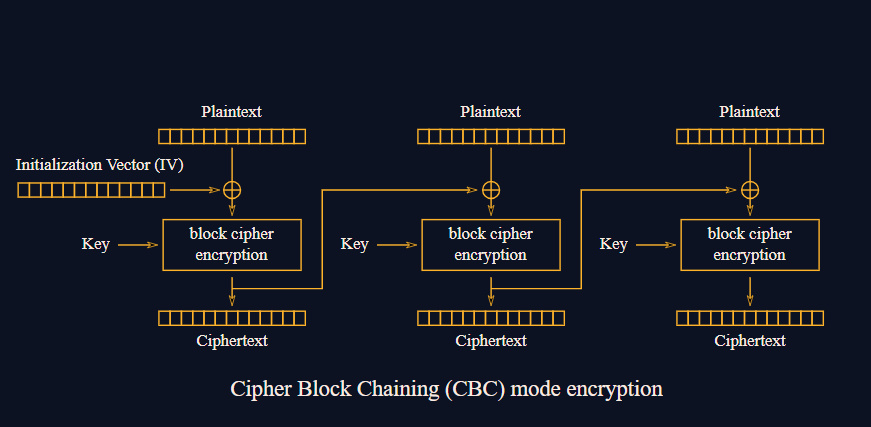
- Sử dụng vector khởi tạo $IV$ (initialization vector) ngẫu nhiên có độ dài đúng bằng khối mã hoá, $IV$ không cần giữ bí mật nhưng bắt buộc phải không thể dự đoán trước.
- Nguyên lý mã hóa:
- Đầu tiên, ta lấy
plaintextXOR với $IV$, sau đó CBC sẽ lấy kết quả đó mã hóa và trả vềciphertextblock $$C_1 = E_K(P_1 \oplus IV)$$- Trong khối mã hóa tiếp theo, ta lấy
plaintextxor vớiciphertexttrả về của block trước đó, tiếp tục mã hóa đến block cuối. $$C_i = E_K(P_i \oplus C_{i-1})$$- Nguyên lý giải mã:
Quy trình giải mã diễn ra theo chiều ngược lại:
- Block đầu tiên: $$P_1 = D_K(C_1) \oplus IV$$
- Các block tiếp theo: $$P_i = D_K(C_i) \oplus C_{i-1}$$
Nhận xét
Mode CBC khắc phục được điểm yếu của Mode ECB nhưng cũng có những điểm yếu có thể bị khai thác.
- Ưu điểm: Xóa bỏ Pattern Leakage: Nhờ cơ chế liên kết chuỗi (chaining) qua phép XOR, hai khối
Plaintextgiống hệt nhau ($P_i = P_j$) khi mã hóa sẽ cho ra hai khốiCiphertexthoàn toàn khác nhau ($C_i \neq C_j$). - Nhược điểm:
- Mã hóa tuần tự: Không thể song song hóa (parallelize) quá trình mã hóa vì block sau phụ thuộc vào kết quả của block trước (tuy nhiên quá trình giải mã thì vẫn song song hóa được)
- Nhạy cảm với Padding (Bit-Flip & Padding Oracle Attack): Nếu tấn công thay đổi 1 bit trên $C_{i-1}$, khi giải mã thì $P_i$ sẽ bị biến đổi tương ứng ở đúng vị trí bit đó. Đây là cơ sở cho các dạng bài tấn công CBC Bit-Flip và Padding Oracle Attack.
3. Phân tích
Phân tích source code:
from Crypto.Cipher import AES
import os


KEY = ?
FLAG = ?


@chal.route('/ecbcbcwtf/decrypt/<ciphertext>/')
def decrypt(ciphertext):
    ciphertext = bytes.fromhex(ciphertext)

    cipher = AES.new(KEY, AES.MODE_ECB)
    try:
        decrypted = cipher.decrypt(ciphertext)
    except ValueError as e:
        return {"error": str(e)}

    return {"plaintext": decrypted.hex()}


@chal.route('/ecbcbcwtf/encrypt_flag/')
def encrypt_flag():
    iv = os.urandom(16)

    cipher = AES.new(KEY, AES.MODE_CBC, iv)
    encrypted = cipher.encrypt(FLAG.encode())
    ciphertext = iv.hex() + encrypted.hex()

    return {"ciphertext": ciphertext}
- Hàm
decrypt(ciphertext)giải mã ciphertext sử dụng mode ECB :cipher = AES.new(KEY, AES.MODE_ECB) - Hàm
encrypt_flag()mã hóa FLAG bằng mode CBC với $IV$ được tạo từiv = os.urandom(16): tạo ra một chuỗi gồm 16 bytes ngẫu nhiên. Ciphertext trả về bao gồm $IV$ (16 bytes đầu) và phần FLAG được mã hóa bằng mode CBC
Ta thấy để giải mã mode CBC cần XOR Ciphertext đã được decrypt của khối hiện tại với Ciphertext khối trước đó (IV đối với khối đầu tiên)để lấy được Plaintext của khối hiện tại.
Vậy ta chỉ cần thêm bước XOR local để khôi phục lại plaintext và nối các khối plaintext để lấy được flag cuối cùng.
4. Lời giải
import requests

BASE_URL = "https://aes.cryptohack.org/ecbcbcwtf/"
#Gửi request để lấy ciphertext
r = requests.get(f"{BASE_URL}/encrypt_flag/").json()
ciphertext_hex = r["ciphertext"]
ciphertext = bytes.fromhex(ciphertext_hex)
#Chia ciphertext thành các khối 16 bytes
C = [ciphertext[i:i + 16]

for i in range(0,len(ciphertext),16)]
P=[]
#Hàm gửi ciphertext để lâý plaintext được giải mã bằng ECB
def decrypt(ciphertext):
    response = requests.get(f"{BASE_URL}/decrypt/{ciphertext.hex()}/")
    data = response.json()
    return bytes.fromhex(data["plaintext"])
#Sử dụng xOR để khôi phục flag
for i in range(1,len(C)):
    c= decrypt(C[i])
    P.append(bytes(a^b for a,b in zip(c,C[i-1])))
flag= b"".join(P)
print(flag)
Flag: crypto{3cb_5uck5_4v01d_17_!!!!!}
Flipping cookie
1. Đề bài
You can get a cookie for my website, but it won’t help you read the flag… I think.
Play at https://aes.cryptohack.org/flipping_cookie
2. Phân tích
Source code:
from Crypto.Cipher import AES
import os
from Crypto.Util.Padding import pad, unpad
from datetime import datetime, timedelta


KEY = ?
FLAG = ?


@chal.route('/flipping_cookie/check_admin/<cookie>/<iv>/')
def check_admin(cookie, iv):
    cookie = bytes.fromhex(cookie)
    iv = bytes.fromhex(iv)

    try:
        cipher = AES.new(KEY, AES.MODE_CBC, iv)
        decrypted = cipher.decrypt(cookie)
        unpadded = unpad(decrypted, 16)
    except ValueError as e:
        return {"error": str(e)}

    if b"admin=True" in unpadded.split(b";"):
        return {"flag": FLAG}
    else:
        return {"error": "Only admin can read the flag"}


@chal.route('/flipping_cookie/get_cookie/')
def get_cookie():
    expires_at = (datetime.today() + timedelta(days=1)).strftime("%s")
    cookie = f"admin=False;expiry={expires_at}".encode()

    iv = os.urandom(16)
    padded = pad(cookie, 16)
    cipher = AES.new(KEY, AES.MODE_CBC, iv)
    encrypted = cipher.encrypt(padded)
    ciphertext = iv.hex() + encrypted.hex()

    return {"cookie": ciphertext}
- Hàm
check_adminnhận input cookie và iv người dùng nhập vào, chuyển cookie và iv từ hex về bytes, sau đó giải mã cookie theoAES.MODE_CBCvới vector khởi tạo là iv, unpad cookie đã được giải mã. Nếu nhận được chuỗi b"admin=True" trong cookie đã được nối, output trả ra là FLAG, nếu không sẽ thông báo bạn không phải admin. - Hàm
get_cookiecookie gốc là chuỗi kí tự f"admin=False;expiry={expires_at}" với expires_at là dấu thời gian ở thời điểm lấy. iv được chọn ngẫu nhiên có độ dài 16 bytes. Cookie được pad thành các khối 16 bytes và mã hóa bằngAES.MODE_CBCvới vector khởi tạo là iv. Output là ciphertext dạng hex được ghép từ iv và cookie đã mã hóa.
Để lấy được FLAG ta cần thay đổi ciphertext để phần cookie sau khi giải mã sẽ thay đổi từ “admin=False” sang “admin=True”
Áp dụng thuật tấn công Bit-Flipping Attack
Bit-Flipping Attack
Tham khảo: https://www.bigous.me/technical/cbc-bit-flipping-en/
Bit-Flipping ( Tấn công lật bit ) cho phép ta thao túng, thay đổi dữ liệu mà không cần biết khóa bí mật KEY.
$$P_i = D_K(C_i) \oplus C_{i-1}$$
Ta có công thức giải mã của AES mode CBC:$$ \iff D_K(C_i) = P_i\oplus C_{i-1}$$
Ta cần biến đổi $P_i$ thành $P_i'$, khi đó:
$$P_i' = D_K(C_i) \oplus C_{i-1}'$$$$ \iff P_i' = P_i\oplus C_{i-1} \oplus C_{i-1}'$$$$ \iff C_{i-1}' = P_i\oplus C_{i-1} \oplus P_i' $$
$$IV' = P_0\oplus IV \oplus P_0' $$
Với $P_{0}$:Vậy, không cần Key, ta vẫn có thể thay đổi Plaintext khi biết được cấu trúc của khối Plaintext gốc tại vị trí muốn thay đổi.
Quay trở lại với bài toán, ta phân tích ciphertext lấy được, phần plaintext ta cần thay đổi nằm ở khối $C_{0}$. Ta thực hiện phép XOR local:
$$IV' = P_0\oplus IV \oplus P_0'$$Trong đó:
- $P_{0}$ : Khối plaintext gốc chứa b"admin=Fals"
- $IV$ : Khối ciphertext đầu trả về của hàm
get_cookie - $P_{0}'$ : Khối plaintext mục tiêu chứa b"admin=True"
3. Lời giải
import requests

BASE_URL = "https://aes.cryptohack.org"

#Lấy cookie từ server
r = requests.get(f"{BASE_URL}/flipping_cookie/get_cookie/")
cookie_hex = r.json()["cookie"]
cookie = bytes.fromhex(cookie_hex)

# Tách IV (16 bytes đầu) và Ciphertext phần sau
iv = cookie[:16]
ciphertext = cookie[16:].hex()

# Xác định khối plaintext gốc (P0) và khối plaintext mục tiêu (P0') đúng 16 bytes
P0 = b"admin=False;expi"
P_fixed = b"admin=True;expir" # thêm các kí tự tiếp theo 'expiry' để đủ 16 bytes

# Tính toán IV mới
iv_new = bytes(b1 ^ b2 ^ b3 for b1, b2, b3 in zip(P0, iv, P_fixed))
iv_new_hex = iv_new.hex()

#Gửi request kiểm tra admin để lấy flag
response = requests.get(
    f"{BASE_URL}/flipping_cookie/check_admin/{ciphertext}/{iv_new_hex}/"
)
data = response.json()

print(data["flag"])
Flag: crypto{4u7h3n71c4710n_15_3553n714l}
Lazy CBC
1. Đề bài
I’m just a lazy dev and want my CBC encryption to work. What’s all this talk about initialisations vectors? Doesn’t sound important.
Play at https://aes.cryptohack.org/lazy_cbc
2. Phân tích
Source code:
from Crypto.Cipher import AES


KEY = ?
FLAG = ?


@chal.route('/lazy_cbc/encrypt/<plaintext>/')
def encrypt(plaintext):
    plaintext = bytes.fromhex(plaintext)
    if len(plaintext) % 16 != 0:
        return {"error": "Data length must be multiple of 16"}

    cipher = AES.new(KEY, AES.MODE_CBC, KEY)
    encrypted = cipher.encrypt(plaintext)

    return {"ciphertext": encrypted.hex()}


@chal.route('/lazy_cbc/get_flag/<key>/')
def get_flag(key):
    key = bytes.fromhex(key)

    if key == KEY:
        return {"plaintext": FLAG.encode().hex()}
    else:
        return {"error": "invalid key"}


@chal.route('/lazy_cbc/receive/<ciphertext>/')
def receive(ciphertext):
    ciphertext = bytes.fromhex(ciphertext)
    if len(ciphertext) % 16 != 0:
        return {"error": "Data length must be multiple of 16"}

    cipher = AES.new(KEY, AES.MODE_CBC, KEY)
    decrypted = cipher.decrypt(ciphertext)

    try:
        decrypted.decode() # ensure plaintext is valid ascii
    except UnicodeDecodeError:
        return {"error": "Invalid plaintext: " + decrypted.hex()}

    return {"success": "Your message has been received"}
- Hàm
encrypt(plaintext)và hàmreceive(ciphertext)đơn giản là hai hàm mã hóa plaintext và giải mã ciphertext để gửi đi tin nhắn, hàmreceive(ciphertext)chỉ trả về plaintext đã decrypt chỉ khi kiểm tra decrypted.decode() không phải ASCII. - Hàm
get_flag(key)là hàm kiểm tra key, nếu người dùng nhập đúng key = KEY sẽ trả về FLAG.
Điểm đặc biệt là tác giả chương trình CBC encryption này “lười” nên đã dùng $IV$ làm $KEY$, nhưng không biết $IV$ có thể khôi phục được.
Ta có
Suy ra
$$P_1 \oplus P_2= D_K(C_1) \oplus IV \oplus D_K(C_2) \oplus C_1$$Nếu chọn các giá trị $C_1$, $C_2$ đều bằng 0, ta sẽ được
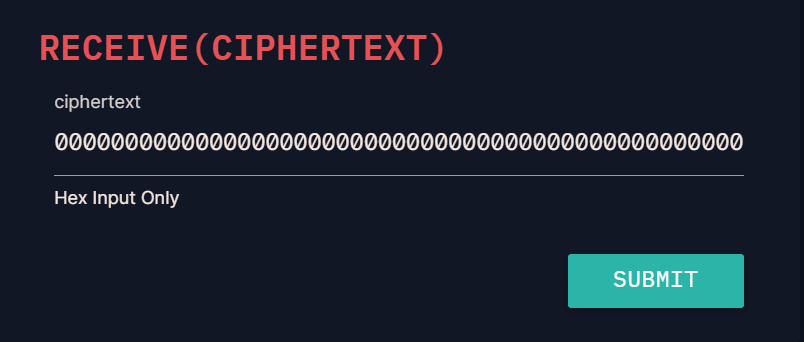
$$P_1 \oplus P_2= D_K(0) \oplus IV \oplus D_K(0) \oplus 0= IV$$Vậy ta nhập ciphertext là 2 khối 0 16 bytes ( 32x2 số 0 dạng hex) vào hàm receive(ciphertext) lúc này khối plaintext trả về sẽ khác ASCII nên chương trình sẽ trả plaintext đã được decrypt cho ta, XOR 2 khối plaintext nhận được và lấy được key dạng hex.
3. Lời giải
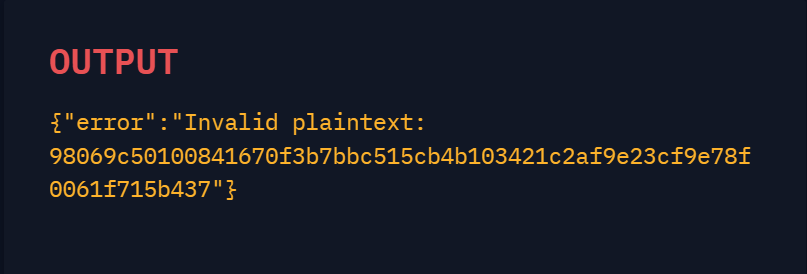
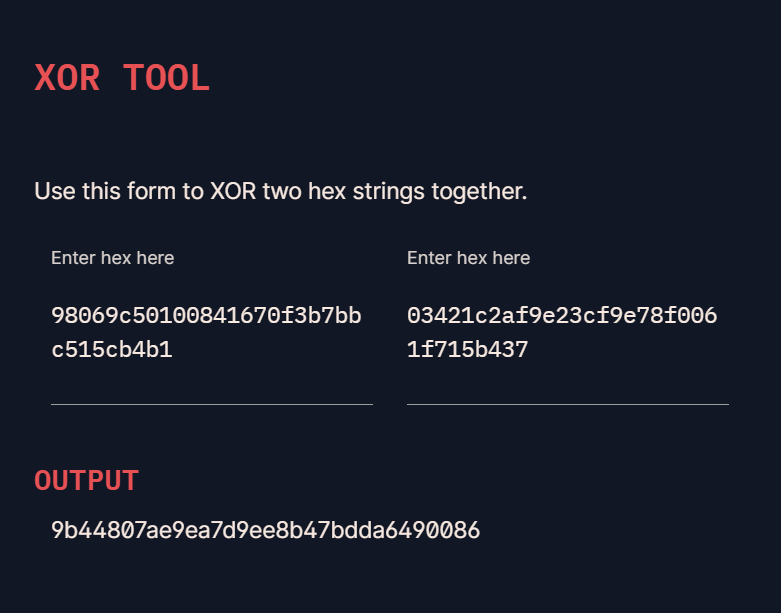
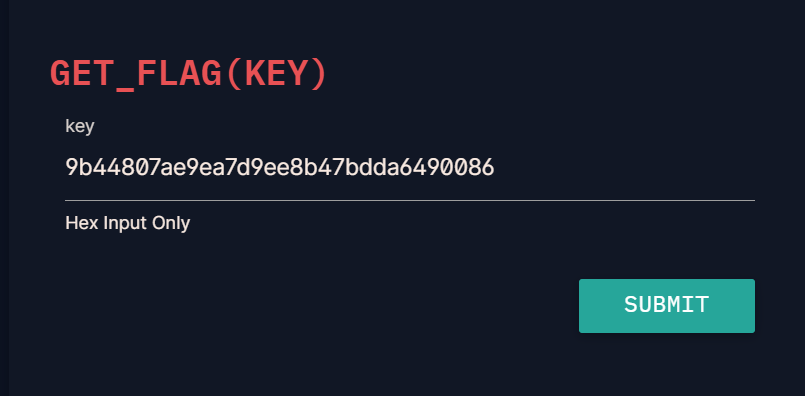
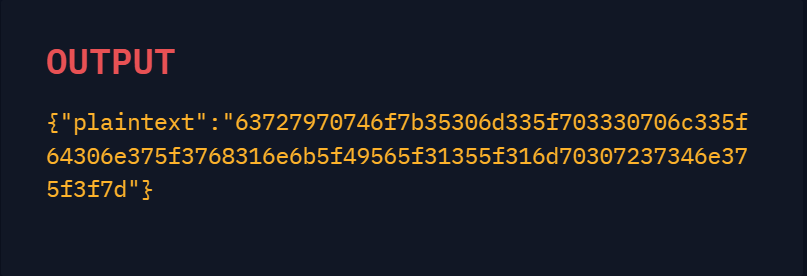
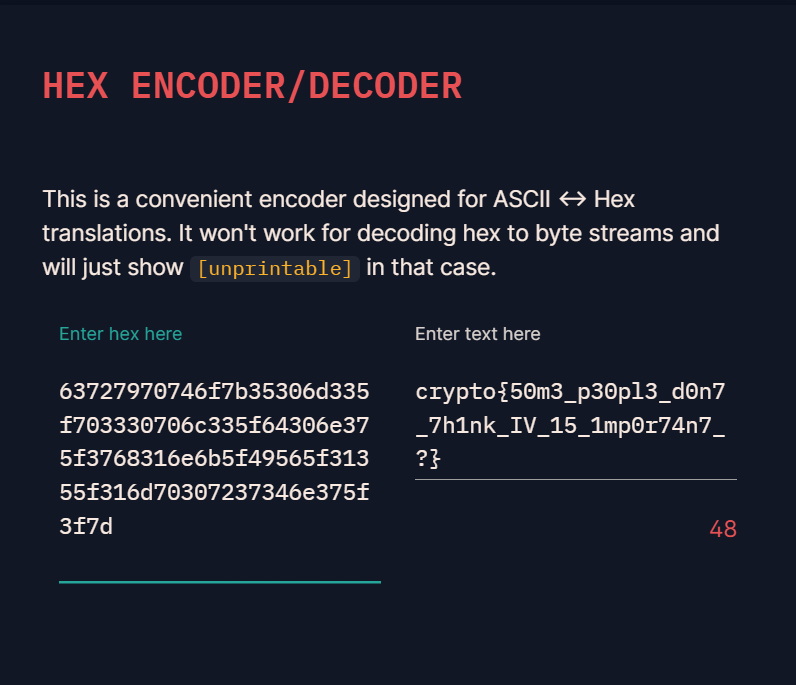
Flag: crypto{50m3_p30pl3_d0n7_7h1nk_IV_15_1mp0r74n7_?}
Double DES (DH)
1. Đề bài
It’s as simple as a 4-byte full survey!
This is a problem we practice together in Exploit Tech: Meet in the Middle Attack.
Source code prob.py
#!/usr/bin/env python3
from Crypto.Cipher import DES
import signal
import os

if __name__ == "__main__":
    signal.alarm(15)

    with open("flag", "rb") as f:
        flag = f.read()

    key = b'Dream_' + os.urandom(4) + b'Hacker'
    key1 = key[:8]
    key2 = key[8:]
    print("4-byte Brute-forcing is easy. But can you do it in 15 seconds?")
    cipher1 = DES.new(key1, DES.MODE_ECB)
    cipher2 = DES.new(key2, DES.MODE_ECB)
    encrypt = lambda x: cipher2.encrypt(cipher1.encrypt(x))
    decrypt = lambda x: cipher1.decrypt(cipher2.decrypt(x))

    print(f"Hint for you :> {encrypt(b'DreamHack_blocks').hex()}")

    msg = bytes.fromhex(input("Send your encrypted message(hex) > "))
    if decrypt(msg) == b'give_me_the_flag':
        print(flag)
    else:
        print("Nope!")
2. Phân tích
Phân tích source code:
signal.alarm(15)giới hạn thời gian trong 15skey = b'Dream_' + os.urandom(4) + b'Hacker'key được tạo bằng cách chọn ngẫu nhiên 4 số, ghép vào giữa 2 phần text có sẵn là b’Dream_’ và b’Hacker’. Key sau đó được tách thành key1 và key2key1 = key[:8]key2 = key[8:]key1 8 bytes đầu, key2 8 bytes cuối- Đây là thuật mã hóa và giải mã cơ bản của DES, ta có thể hiểu hàm encrypt và decrypt trên như sau: $$ ct= E_{K2}(E_{K1}(pt))$$ $$ pt= D_{K1}(D_{K2}(ct))$$
cipher1 = DES.new(key1, DES.MODE_ECB) cipher2 = DES.new(key2, DES.MODE_ECB) encrypt = lambda x: cipher2.encrypt(cipher1.encrypt(x)) decrypt = lambda x: cipher1.decrypt(cipher2.decrypt(x)) - Hint trả về là
encrypt(b'DreamHack_blocks').hex()dạng hex của ‘DreamHack_blocks’ đã được mã hóa bằng thuật mã hóa trên. - Để lấy được flag ta cần gửi đúng ciphertext mã hóa của khối ‘give_me_the_flag’ đồng nghĩa với việc khôi phục được key
   if decrypt(msg) == b'give_me_the_flag':
      print(flag)
Để giải quyết bài này, ta sử dụng thuật tấn công Meet in the Middle
Ta có thể brute-force 4 bytes để tìm lại, tương đương $2^{32}$ lần thử nhưng thời gian sẽ vượt quá 15s
Ta có:
Sử dụng hint
$$ \iff D_{K2}(hint)= E_{K1}('DreamHack\_blocks')$$Vậy ta có thể brute-force 2 bytes ở từng key rồi dừng lại khi có giá trị thỏa mãn hai phép $D_{K2}(hint)$ và $E_{K1}('DreamHack\_blocks')$ cho giá trị giống nhau.
Tới đây ta có thể dùng dict hoặc set trong Python để duyệt dữ liệu và chỉ dùng 2 vòng for độc lập, số lần thử $2^{16}$+$2^{16}$.
3. Lời giải
from pwn import *
from Crypto.Cipher import DES
#io = process(["python3", "prob.py"])
io = remote("host3.dreamhack.games", 21073)
io.recvuntil(b":> ")

hint = bytes.fromhex(io.recvline().decode())
conflict = dict()

for i in range(65536):
    b = i.to_bytes(2, "big")
    cipher = DES.new(b"Dream_" + b, DES.MODE_ECB)
    enc = cipher.encrypt(b"DreamHack_blocks")
    conflict[enc] = b"Dream_" + b

for i in range(65536):
    b = i.to_bytes(2, "big")
    cipher = DES.new(b + b"Hacker", DES.MODE_ECB)
    dec = cipher.decrypt(hint)

    if dec in conflict:
        key1 = conflict[dec]
        key2 = b + b"Hacker"
        break

cipher1 = DES.new(key1, DES.MODE_ECB)
cipher2 = DES.new(key2, DES.MODE_ECB)
encrypt = lambda x: cipher2.encrypt(cipher1.encrypt(x))
assert encrypt(b"DreamHack_blocks") == hint

io.sendlineafter(b'> ', encrypt(b"give_me_the_flag").hex().encode())

flag = eval(io.recvline())
io.close()

print(flag.decode())
Triple DES
1. Đề bài
Data Encryption Standard was the forerunner to AES, and is still widely used in some slow-moving areas like the Payment Card Industry. This challenge demonstrates a strange weakness of DES which a secure block cipher should not have.
Play at https://aes.cryptohack.org/triple_des
2. Phân tích
Source code
from Crypto.Cipher import DES3
from Crypto.Util.Padding import pad
import os


IV = os.urandom(8)
FLAG = ?


def xor(a, b):
    # xor 2 bytestrings, repeating the 2nd one if necessary
    return bytes(x ^ y for x,y in zip(a, b * (1 + len(a) // len(b))))


@chal.route('/triple_des/encrypt/<key>/<plaintext>/')
def encrypt(key, plaintext):
    try:
        key = bytes.fromhex(key)
        plaintext = bytes.fromhex(plaintext)
        plaintext = xor(plaintext, IV)

        cipher = DES3.new(key, DES3.MODE_ECB)
        ciphertext = cipher.encrypt(plaintext)
        ciphertext = xor(ciphertext, IV)

        return {"ciphertext": ciphertext.hex()}

    except ValueError as e:
        return {"error": str(e)}


@chal.route('/triple_des/encrypt_flag/<key>/')
def encrypt_flag(key):
    return encrypt(key, pad(FLAG.encode(), 8).hex())
Ở bài này, ta được chọn key cho chương trình mã hóa DES3
Phép mã hóa DES có điểm yếu là tồn tại các cặp khóa yếu
0101010101010101 FEFEFEFEFEFEFEFE
0000000000000000 FFFFFFFFFFFFFFFF
0000000000000000 FEFEFEFEFEFEFEFE
0101010101010101 FFFFFFFFFFFFFFFF
Khi dùng cặp khóa yếu $K_1$, $K_2$ thì:
$$ E_{K_{1}}(E_{K_{2}}(P))=P$$Hay phép mã hóa bằng $K_2$ sẽ chính là phép giải mã bằng $K_1$
$$E_{K_{2}}=D_{K_{1}}$$Ngoài ra
$$ \quad D_{K_2}(D_{K_2}(X)) = E_{K_1}(E_{K_1}(X)) = X$$Hàm mã hóa DES3có nguyên tắc encrypt như sao:
Bài thêm một bước XOR với $IV$, quá trình encrypt của hàm encrypt(key, plaintext) là:
Bộ khóa ($K_1$,$K_2$,$K_3$) có các tiêu chuẩn lựa chọn sau:
- Lựa chọn 1: $K_1$,$K_2$,$K_3$ là các khóa độc lập
- Lựa chọn 2: $K_1$,$K_2$ là hai khóa độc lập và $K_3$=$K_1$
- Lựa chọn 3: $K_1$=$K_2$=$K_3$
Ở bài này chỉ nhận input key có dạng tiêu chuẩn 1 hoặc 2, khi nhập key dạng tiêu chuẩn 3 sẽ có thông báo lỗi
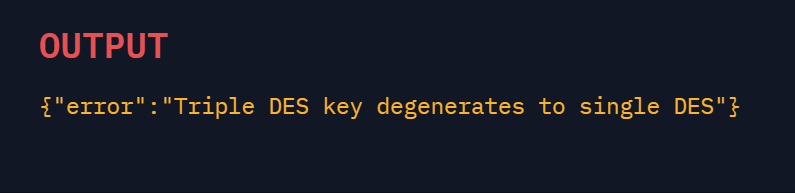
Dùng cặp khóa yếu 0101010101010101 FEFEFEFEFEFEFEFE
Khi đó hàm encrypt trở thành
Encrypt thêm một lần nữa:
$$ct'= D_{K2}(D_{K2}(pt \oplus IV) \oplus IV \oplus IV) \oplus IV$$$$ = D_{K2}(D_{K2}(pt \oplus IV)) \oplus IV$$$$=pt \oplus IV\oplus IV=pt$$Vậy với cặp khóa yếu, việc lấy được flag trở nên đơn giản, ta chỉ cần encrypt phần ciphertext encrypt của flag (hay encrypt flag 2 lần), ciphertext trở về chính là flag đã được giải mã!
3. Lời giải
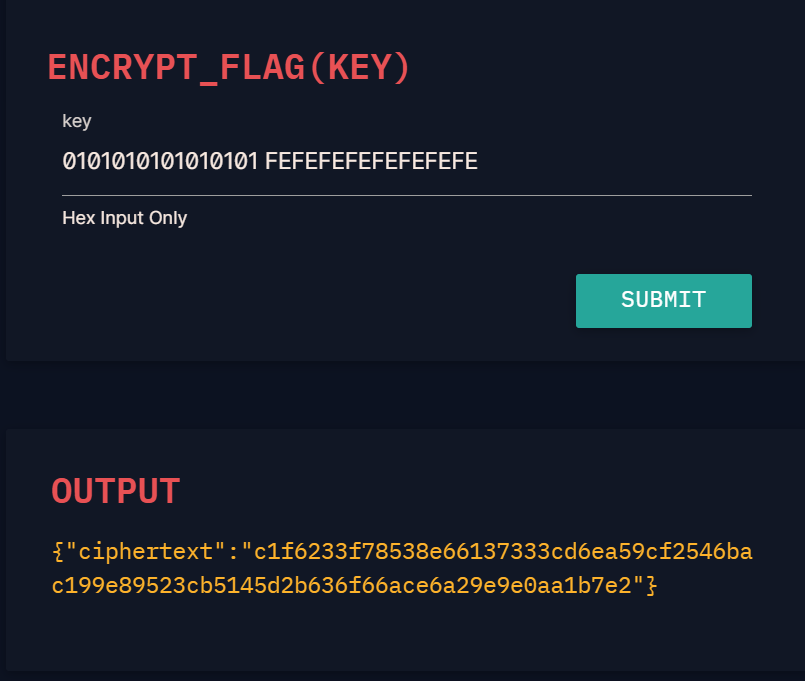
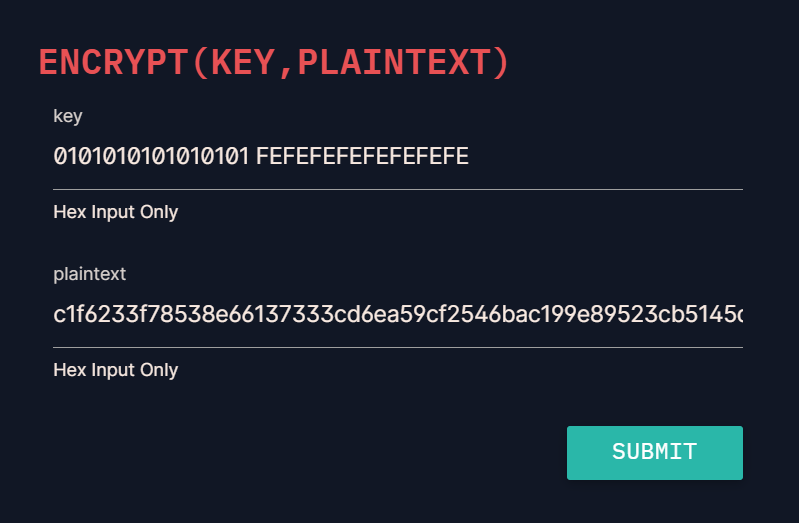
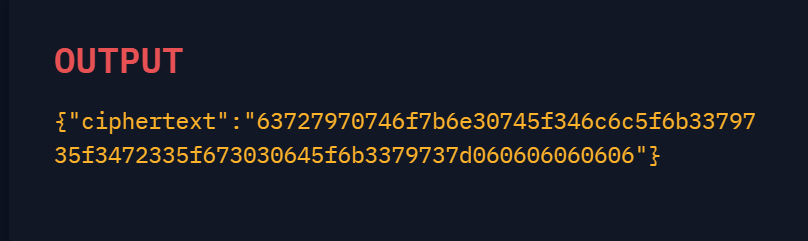
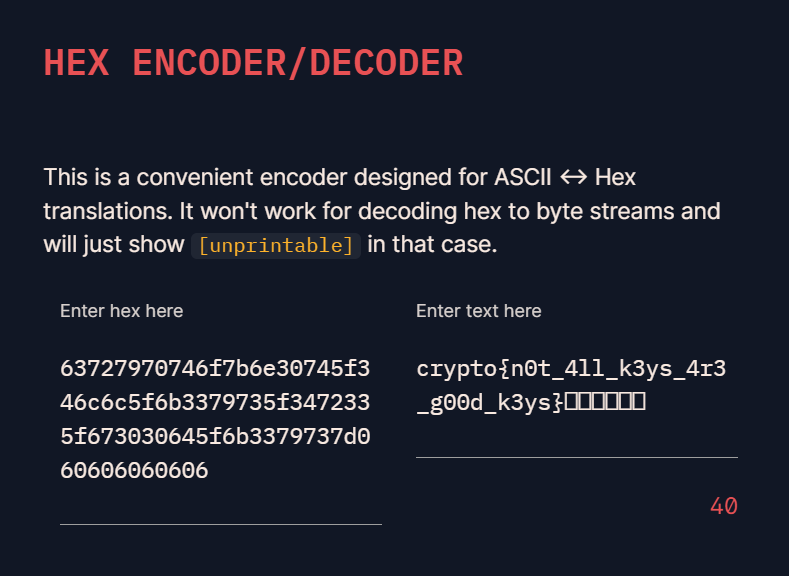
Flag: crypto{n0t_4ll_k3ys_4r3_g00d_k3ys}
Stream Ciphers
Symmetry
1. Đề bài
Some block cipher modes, such as OFB, CTR, or CFB, turn a block cipher into a stream cipher. The idea behind stream ciphers is to produce a pseudorandom keystream which is then XORed with the plaintext. One advantage of stream ciphers is that they can work of plaintext of arbitrary length, with no padding required.
OFB is an obscure cipher mode, with no real benefits these days over using CTR. This challenge introduces an unusual property of OFB.
Play at https://aes.cryptohack.org/symmetry
2. Phân tích
Source code
from Crypto.Cipher import AES
import os


KEY = ?
FLAG = ?


@chal.route('/symmetry/encrypt/<plaintext>/<iv>/')
def encrypt(plaintext, iv):
    plaintext = bytes.fromhex(plaintext)
    iv = bytes.fromhex(iv)
    if len(iv) != 16:
        return {"error": "IV length must be 16"}

    cipher = AES.new(KEY, AES.MODE_OFB, iv)
    encrypted = cipher.encrypt(plaintext)
    ciphertext = encrypted.hex()

    return {"ciphertext": ciphertext}


@chal.route('/symmetry/encrypt_flag/')
def encrypt_flag():
    iv = os.urandom(16)

    cipher = AES.new(KEY, AES.MODE_OFB, iv)
    encrypted = cipher.encrypt(FLAG.encode())
    ciphertext = iv.hex() + encrypted.hex()

    return {"ciphertext": ciphertext}
Một số chế độ mã hóa khối, chẳng hạn như OFB, CTR hoặc CFB, chuyển đổi một thuật toán mã hóa khối thành một thuật toán mã hóa dòng (stream cipher).
Ý tưởng đằng sau các thuật toán mã hóa dòng (stream cipher) là tạo ra một chuỗi khóa giả ngẫu nhiên (pseudorandom keystream), sau đó chuỗi này được XOR với bản rõ.
Một ưu điểm của stream cipher là chúng có thể hoạt động trên bản rõ có độ dài bất kỳ mà không yêu cầu padding
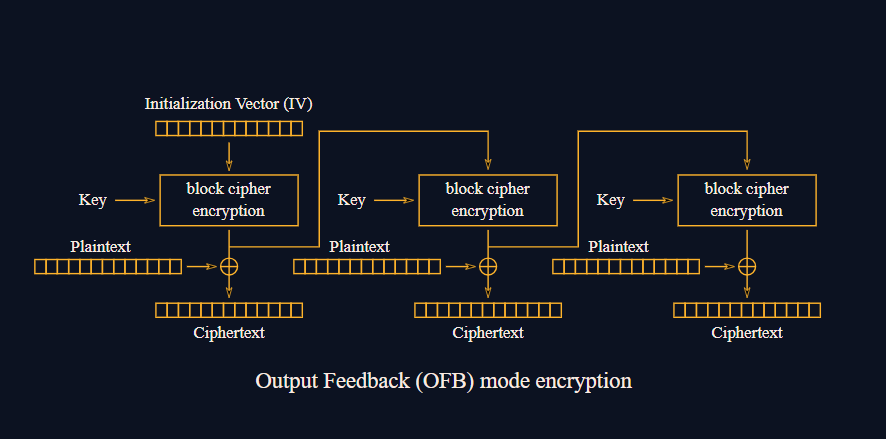
AES.MODE_OFB
Thay vì mã hóa trực tiếp bản rõ (plaintext), chế độ OFB dùng thuật toán AES để mã hóa $IV$ và các đầu ra tiếp theo của chính nó để sinh ra
$$KS_1 = \text{AES\_Encrypt}_K(IV)$$$$...$$$$KS_i = \text{AES\_Encrypt}_K(KS_{i-1})$$keystream
- Mã hóa (encrypt): $$C_i = P_i \oplus KS_i$$
- Giải mã (decrypt): $$P_i = C_i \oplus KS_i$$ Ta thấy phép mã hóa cũng chính là phép giải mã
Bài này giới thiệu chế độ mã hóa AES.MODE_OFB, và đặc điểm của chế độ này là nó ‘Symmetry’ (đối xứng), thuật encrypt cũng là thuật decrypt.
Hàm encrypt_flag() sẽ trả về $IV$ và ciphertext của flag đã được encrypt mode OFB.
Để giải mã ta chỉ cần dùng hàm encrypt(plaintext, iv) vừa là hàm mã hóa vừa là hàm giải mã để giải mã.
3. Lời giải
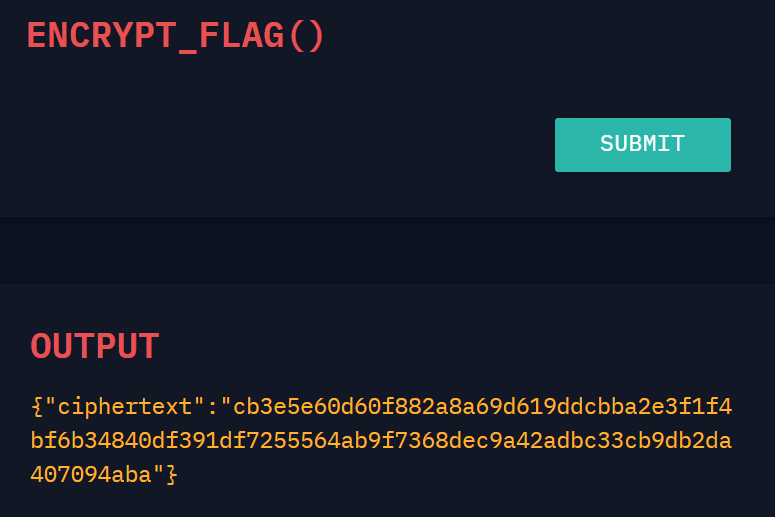
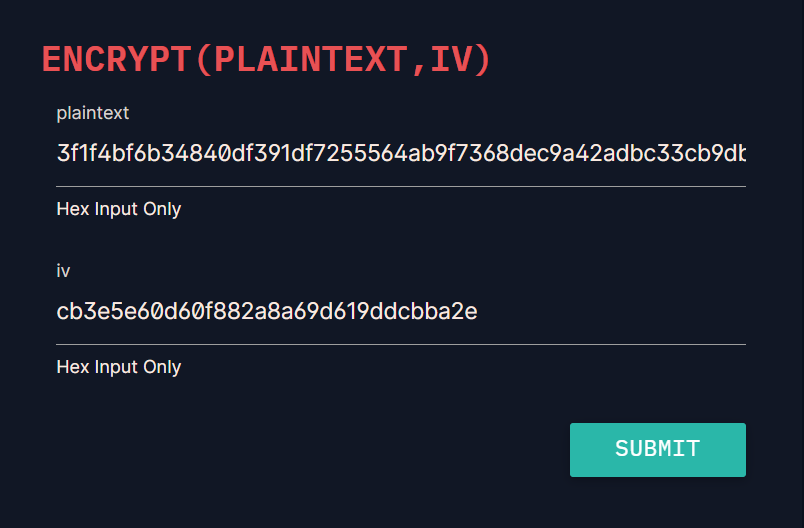
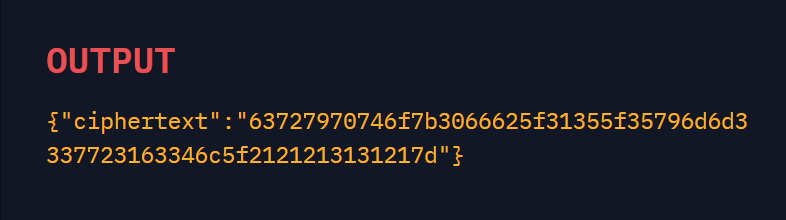
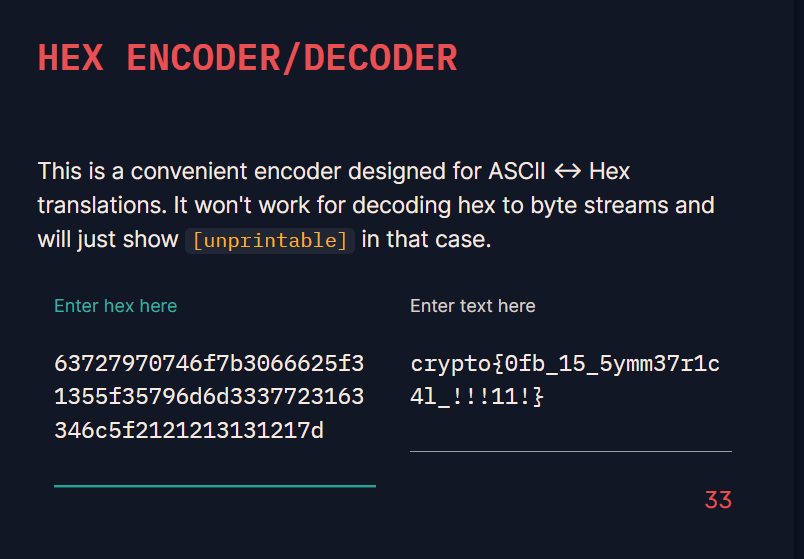
Flag: crypto{0fb_15_5ymm37r1c4l_!!!11!}
Bean Counter
1. Đề bài
I’ve struggled to get PyCrypto’s counter mode doing what I want, so I’ve turned ECB mode into CTR myself. My counter can go both upwards and downwards to throw off cryptanalysts! There’s no chance they’ll be able to read my picture.
Play at https://aes.cryptohack.org/bean_counter
2. Phân tích
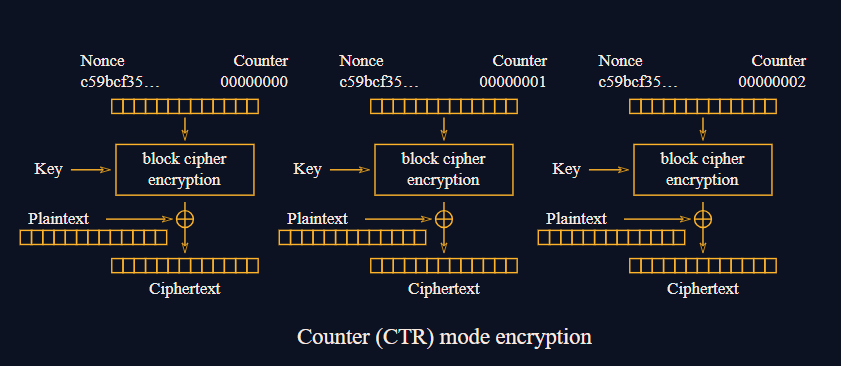
Chế độ Mã hóa CTR (Counter Mode)
Chế độ Mã hóa CTR (Counter Mode) là một trong những chế độ vận hành mã hóa khối (Block Cipher Mode of Operation) phổ biến và an toàn nhất hiện nay. Điểm đặc trưng của CTR là biến một thuật toán mã hóa khối (như AES, DES, Camellia) thành một mã hóa dòng (Stream Cipher) hoàn chỉnh.
Thay vì trực tiếp mã hóa văn bản gốc (Plaintext), thuật toán mã hóa một chuỗi các biến đếm (Counter) độc lập để tạo ra chuỗi Keystream. Sau đó, Keystream được kết hợp với Plaintext bằng phép toán XOR.Encryption:
- Khởi tạo chuỗi đếm: $$T_i = \text{Nonce} \parallel \text{Counter}_i$$
- Sinh Keystream: $$K_i = E_{K}(T_i)$$
- Mã hóa khối: $$C_i = P_i \oplus K_i$$ Decryption:
- Sinh lại Keystream: $$K_i = E_{K}(T_i)$$
- Khôi phục Plaintext: $$P_i = C_i \oplus K_i$$
Trong đó:
- $\text{Nonce}$ (Number used once): Chuỗi định danh ngẫu nhiên hoặc duy nhất cho mỗi phiên mã hóa.
- $\text{Counter}_i$: Biến đếm tăng dần cho mỗi khối ($0, 1, 2, \dots$).
from Crypto.Cipher import AES
import os


KEY = ?


class StepUpCounter(object):
    def __init__(self, step_up=False):
        self.value = os.urandom(16).hex()
        self.step = 1
        self.stup = step_up

    def increment(self):
        if self.stup:
            self.newIV = hex(int(self.value, 16) + self.step)
        else:
            self.newIV = hex(int(self.value, 16) - self.stup)
        self.value = self.newIV[2:len(self.newIV)]
        return bytes.fromhex(self.value.zfill(32))

    def __repr__(self):
        self.increment()
        return self.value


@chal.route('/bean_counter/encrypt/')
def encrypt():
    cipher = AES.new(KEY, AES.MODE_ECB)
    ctr = StepUpCounter()

    out = []
    with open("challenge_files/bean_flag.png", 'rb') as f:
        block = f.read(16)
        while block:
            keystream = cipher.encrypt(ctr.increment())
            xored = [a^b for a, b in zip(block, keystream)]
            out.append(bytes(xored).hex())
            block = f.read(16)

    return {"encrypted": ''.join(out)}
Phân tích source code:
- Class
StepUpCounter()tạo ra chuỗi IV 16 bytes thay đổi sau mỗi block 16 bytes của ciphertext.’ - Hàm
increment(self)
def increment(self):
    if self.stup:
        self.newIV = hex(int(self.value, 16) + self.step)
    else:
        self.newIV = hex(int(self.value, 16) - self.stup)
    self.value = self.newIV[2:len(self.newIV)]
    return bytes.fromhex(self.value.zfill(32))
là hàm tạo IV mới. Trong đó hàm sẽ kiểm tra self.stup:
- Nếu True sẽ thực hiện +
self.stephay biến đếm +1 - Nếu False sẽ sẽ thực hiện -
self.stupNhưng nếu không truyền dữ liệu, giá trị cố định của step_up=False nên sẽ thực hiệnself.newIV = hex(int(self.value, 16) - self.stup)hayself.newIV = hex(int(self.value, 16))vì self.stup=0.
Khi đó, giá trị IV mới bằng IV cũ hay keystream = AES_encrypt(IV) bị trùng lặp, dùng cùng 1 keystream cho tất cả các khối.
Vậy chỉ cần khôi phục keystream đầu ta có thể mã hóa hết ciphertext bằng cách xor mỗi khối với keystream.
Vì file mã hóa là png nên ta biết được khối plaintext 16 bytes đầu tiên sẽ là:89504e470d0a1a0a0000000d49484452. Ta có thể dễ dàng khôi phục keystream của khối bằng cách xor plaintext đã biết với ciphertext encrypted.
3. Lời giải
import requests
c = bytes.fromhex(requests.get("https://aes.cryptohack.org/bean_counter/encrypt/").json()["encrypted"])
known = bytes.fromhex("89504e470d0a1a0a0000000d49484452")
keystream = bytes(a ^ b for a, b in zip(c, known))
open("flag.png", "wb").write(bytes(b ^ keystream[i % 16] for i, b in enumerate(c)))
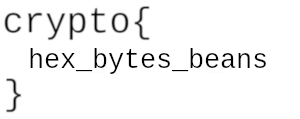
Flag: crypto{hex_bytes_beans}